 |
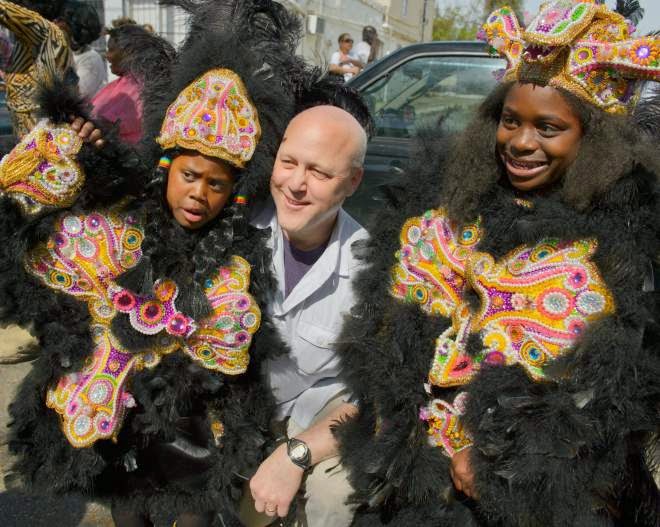
| Indians with Mayor Landrieu/Photo: Matthew Hinton, The Advocate |
After a 15-year hiatus from masking, a Mardi Gras Indian sewing legend and his queen hit the streets this year in a pair of stunning black suits. Big Chief Tyrone “Pie” Stevenson, 54, chose black feathers for his entire tribe: his Big Queen and life partner, Denice Smith, plus a little chief, four little queens, two flagboys and a medicine man.
On Sunday, the Monogram Hunters tribe dressed at Stevenson’s home in the Gentilly area, then piled into SUVs and pickups bound for A.L. Davis Park in Central City, the starting point for the Indians’ Sunday parade.
The gathering was jam-packed with Indians especially eager to show off their suits this year because their appearances on Mardi Gras Day had been curtailed by heavy rain.
The Uptown procession, sometimes referred to as “Uptown Super Sunday,” is presented annually by the New Orleans Mardi Gras Indian Council on a Sunday close to March 19, St. Joseph’s Night, when the Indians come out in their suits in the evening.
This year’s parade was delayed twice because of rainstorms, putting it at the end of March on what ended up being a gloriously sunny day.
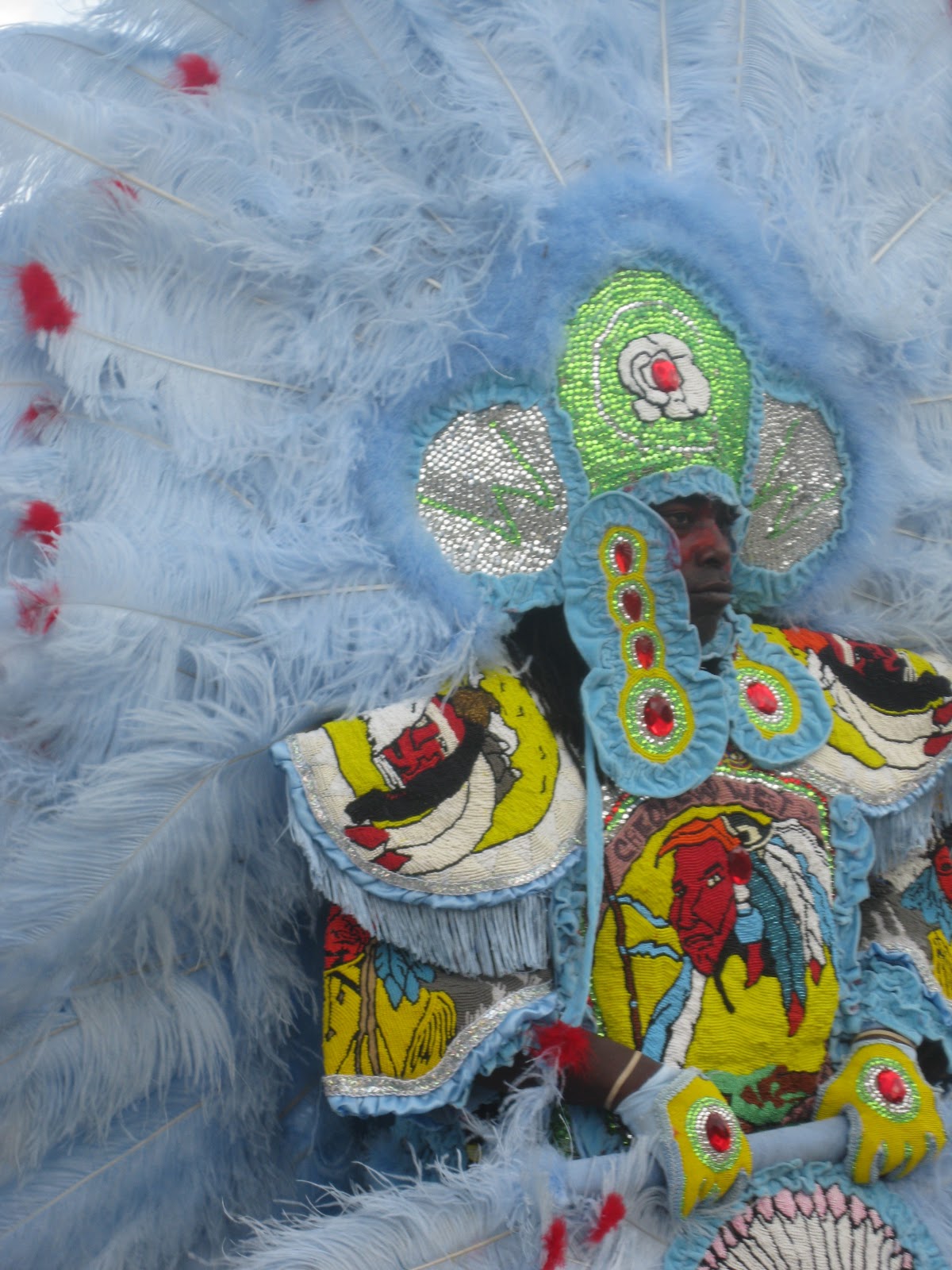
As Stevenson planned, the rays of the sun caught on the gold-metallic lace that edged many of the 3-D elements in his and Smith’s suits. They reflected off the small red mirrors sewn into the suits.
Stevenson chose the somber black feathers, he said, “in homage to everything we’ve been through and to everyone we lost,” including his former leader, Chief of Chiefs Allison “Tootie” Montana, who died in 2005, and his close friend, Big Chief Lionel Delpit, of the Black Feather tribe, who died in 2011.
Black also seemed appropriate as the backdrop for the brightly colored symbols of new life that Stevenson sewed into his suit’s three-dimensional beadwork, including springtime flowers, with petals made of oblong red-rice beads and centers of yellow stone carefully edged with sewn white pearls.
“Like a beautiful flower, that suit almost bursts open in spots,” said Ed Buckner, founding director of The Porch, a 7th Ward cultural organization. “It was as if all the years Chief Pie took off, all the creative ideas he had, all that inspiration went into that one suit.”
The suits were spectacular enough that some Indians even speculated Big Chief Pie had been slowly sewing on his own suit over a few years, creating a scorned “two-year suit” instead of one created entirely within a year’s time, as Indian tradition requires.
Stevenson denied it, saying he started making drawings and cutting cardboard for the suits just after Mardi Gras last year. He and Smith immediately began sewing beads onto the cardboard and in fact threw themselves into the sewing so enthusiastically that the suits were done a few months in advance, he said.
Several years ago, Buckner recruited Stevenson to The Porch, where the chief worked tirelessly teaching his craft to neighborhood children, for what became The Porch’s own tribe, the Red Flame Hunters. Buckner believes it was the young people who inspired Stevenson to mask again, after asking the same question for years: “When can I mask with you?”
Stevenson agreed: The young Indians from The Porch did push him to return. But so did fellow Indians, like FiYiYi Big Chief Victor Harris, who said he saw in his spirit that Stevenson was coming back.
Jerome Smith from the Tambourine and Fan organization told Stevenson he had sat out long enough. “That’s enough of a break,” Smith said to him.
Neighbors also urged him to resume making suits, said his son, Second Chief Jeremy Stevenson: “Every time we’d go to the second line, people would say, ‘You gotta dress, man. We miss you. When are you going to put your suit on?’ ”
For 22 years, like clockwork, Stevenson masked with Tootie Montana’s Yellow Pocahontas, he said, recalling the years in the late 1970s when Montana had more than 100 Indians following him. Montana had formed a tribe called the Monogram Hunters with friends early in his career. But in 1950, he took over the Yellow Pocahontas, the tribe that his great uncle, Becate Batiste, had helped to form before the turn of the 20th century. So in the early 1990s, when Stevenson was ready to form his own tribe, he requested, and received, Montana’s blessing to become the Big Chief of the Monogram Hunters.
The tribe premiered under his leadership in 1992. The following year, the Monogram Hunters marched with 23 Indians. They came out strong for several more years. Then something happened. After 1997, Stevenson quit masking.
Though he has long worked steadily in a French Quarter candy shop, he had teenagers to raise, and his finances felt too tight at that point to spend several thousand dollars on an Indian suit, he said. “It’s hard. You’re taking food off your own table to mask,” he said.
More than that, it seemed his heart wasn’t in it anymore. “I got burnt out,” he said. His nephew, Third Chief Keelian Boyd, saw what his uncle was going through. “His fire went out,” he said.
Though Stevenson wasn’t leading the tribe, the Monogram Hunters didn’t go dormant, said Jeremy Stevenson, who led the Hunters during that time, along with Boyd. “A Monogram Hunter has always hit the streets since 1992. And we always were pretty,” Jeremy Stevenson said.
But some years were tough, financially. Jeremy Stevenson remembered saving beads thrown from Mardi Gras floats and sewing them onto his suit.
At first, Big Chief Stevenson hadn’t wanted to hear about anything having to do with the Indians. But then Boyd asked his uncle to work on his suits with him. Not long afterward, Stevenson started to work with The Porch, and he began to feel a tug inside every year as Mardi Gras approached.
He’d look at the designs he was creating with children. He was proud of the work he was doing with them, and he saw that The Porch’s program was saving youths by pulling them away from the streets. But he began to ask himself, “Where is my suit?”
Last year after Mardi Gras, Smith said, she was tired of hearing people ask when he was coming back. “It’s time,” she told him. “And I’m going to come out with you.”
Soon, it seemed like old times, with pots of red beans bubbling in the kitchen as his small tribe beat tambourines and sang Indian songs together. He and Smith might leave to grab a bite to eat, but then they’d return home, eager to sew.
By Thanksgiving, their tidy Gentilly house was lined with chest plates, aprons, headpieces and feathers.
Smith, a certified nursing assistant, and Stevenson paid their bills and then used anything left to buy beads and feathers, spending nearly $9,000 in all, he estimates. They spent nearly $1,000 just on marabou, the fluffy feathers often used in boas.
He didn’t feel overwhelmed, as he had 15 years ago, when he first put his needle down. “Even if I had a bad day at work, when I touched that design, it was like therapy,” he said. Once again, he felt that he was “sewing with the spirit.”
There is no going back now. Already, Stevenson has drawn and designed next year’s suits, which he promises will be unforgettable.
There will be no more gaps, he said. “Like I told people, ‘If I put a suit on again, I’ll probably mask until I die.’ ”