Showing posts with label Congo Square. Show all posts

Sunday, July 7, 2013

Annual event acknowledges slavery

Photo: Eliot Kamenitz

Ceremony gives tribute to slaves
In 2001, a small group gathered to pay homage to their ancestors. On Saturday, for the 13th time, the annual gathering included hundreds of people at Congo Square — the same site where many slaves sang and prayed more than 200 years ago.
With a white altar sitting beneath oak trees, this year’s Maafa Commemoration opened with “Sunrise at Congo Square,” a three-hour tribute that included worship and celebration. Some arrived before 6 a.m. Saturday to the sound of drums and other music native to western Africa.
A procession followed on foot to St. Augustine Church, where those in attendance prayed at the Tomb of the Unknown Slave, and through the French Quarter, where slaves once were bought and sold. It then traveled to the Canal Street ferry for a sing-along and an offering of gifts to the ancestors.
“Maafa” is a Swahili word meaning great disaster or tragedy, and some represent it to mean African holocaust. Carol Bebelle, co-founder of the Ashé Cultural Arts Center and coordinator of Saturday’s event, said those who suffered “worked from ‘can’t see in the morning until can’t see at night.’ ” A representative of the Zion Trinity offered a song “for all those in the water who jumped ship or who were beaten or burned.”
“This is an opportunity to remind people of this history that is so painful in our country, and to also have people understand that part of being able to distance ourselves from it is to reckon with that past,” Bebelle said. “We need to continue to intentionally work to get as far away from that past as we can. This is a way to force us to reach farther for democracy.”
Others offered praise, in the form of both word and song. That included a dozen children from the Christian Unity Baptist Church in New Orleans, and Grayhawk Perkins, a New Orleans-born Native American Choctaw, who sang with the costumed Spirit of FiYiYi.
Before the congregation left Congo Square, seven white doves were individually released to symbolize and honor both ancestors and those living today. “We won’t bow down, and we will remember” was chanted each time a dove went soaring into the sky.
As it has in the past, the commemoration coincided with the weekend of Essence Festival, and as a result there were many people in the crowd both from the New Orleans area and across the country. In attendance, coincidentally, there was a representative of Congo — a theology professor who is in town spending the summer teaching at Xavier.
“In the Christian experience, it requires an awareness of your own identity and an awareness of your own culture,” said Modeste Malu Nyimi, who also teaches African studies at the Interdenominational Theological Center in Atlanta. “Here, this is like a lab where the African culture is at work elaborating itself. I couldn’t miss this opportunity.”
There was a wide range of those in attendance, as both the young and old prayed together. Many saw it as an opportunity not only to pay homage to their ancestors but to become more aware of just who they are.
“I’m new to all of this, but for me I always wondered if this sort of thing existed,” said someone who would identify himself only as Reginald from Memphis, Tenn. “This represents a wake-up call for me. This gives me a sense of heritage, it gives me a sense of purpose, and it gives me an avenue to understand myself better.
“This was like a homecoming for me.”

Sunday, March 24, 2013

Congo Rhythms Festival at Armstrong Park


Congo Rhythms Festival comes once a year and celebrates the city's African roots. Congo Square is the place slaves gathered on their day off - Sunday - to perform their traditional dances and play drums. As part of the New Orleans Jazz & Heritage Festival Foundation mission, the weekend supports a unique style of music we don't otherwise hear.

I stopped by on both days to hear bits and pieces, primarily by the Stooges Brass Band and Alexey Marti, my zumba instructor's Cuban husband who plays conga drums. I also missed a whole lot of interesting stuff, but what can you do? There's always something wonderful you are missing. As I arrived, so were the Mardi Gras Indians, who paraded through the crowd and then did a war dance in the middle of the plaza. They're wild, as you can see.

I then had a conversation with an artist I've met before and bought jewelry from. He explained dumpster diving to me and how he plans to go home to Guatemala to get his cataracts removed since he can't afford health insurance. He almost had me convinced to try dumpster diving but not the surgery.


Saturday, September 3, 2011

Blacks gathered in Congo Square in 1859

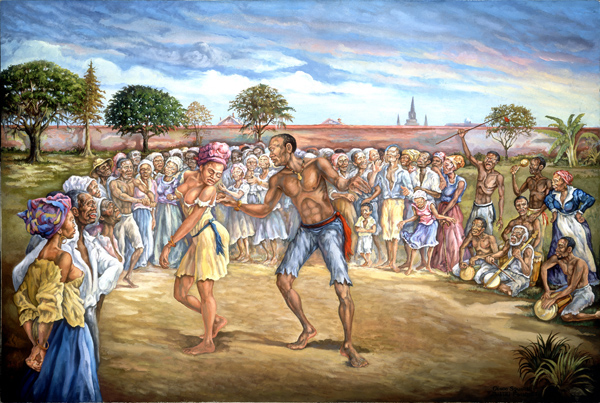
On Sundays, the beats of the drums from Congo Square permeated the city. Under European tradition, slaves were allowed Sundays off from work. Congo Square, an open field next to the French Quarter, was the only place for black people -- both free and enslaved -- to gather and market goods. There they would sing and dance in the tradition of their ancestors.

Authorities started to discourage the gatherings, and they had ended by the beginning of the Civil War.

An 1848 newspaper report suggested readers go to the square to experience its energy. Architect Benjamin Latrobe happened upon the scene in 1818 and wrote: "A man sang an uncouth song to the dancing, which I suppose was in some African language."

Writer George Washington Cable was enchanted by the music in the square: "The gathering throng closed in around, leaving unoccupied the circle indicated by the crescent of musicians. The short, harsh turf was the dancing floor. The crowd stood. Fancy the picture. The pack of dark, tattered figures touched off every here and there with the bright colors of a Madras tignon. The squatting, cross-legged musicians."

Congo Square survives within the Armstrong Park complex. It was the site of the first New Orleans Jazz and Heritage Festival in 1970, in which gospel legend Mahalia Jackson performed. The Mahalia Jackson Theater for the Performing Arts is next to Congo Square.Renamed Beauregard Square in 1893, Congo Square was officially given back its original name by the New Orleans City Council in April 2010.

Frequent events by groups such as Bamboula 2000 continue to draw people to Congo Square today.

Jazz musician Wynton Marsalis said: “The bloodlines of all important modern American music can be traced to Congo Square.
Sunday, February 6, 2011

The spirit of Congo Square lives on

In colonial times, slaves were free on Sundays to gather in the "Place de Negres," just outside the boundaries of the French Quarter, where they would dance, sing, play music and trade wares. The tradition continued after the Louisiana Purchase and the plaza, called Congo Square, became known as the birthplace of jazz.

Congo Square has since been incorporated into Louis Armstrong Park where the Mahalia Jackson Theater was built to showcase opera, symphony and ballet.

To address the violence in the city, a group of residents began a drum circle before Katrina in Congo Square, believing the area was "sacred ground," according to local historian, Jack Radosta.

The group reunited this past weekend, drumming, singing and embracing. Incense was burned at the center of the circle and voices rang out.